
Person as a Vector
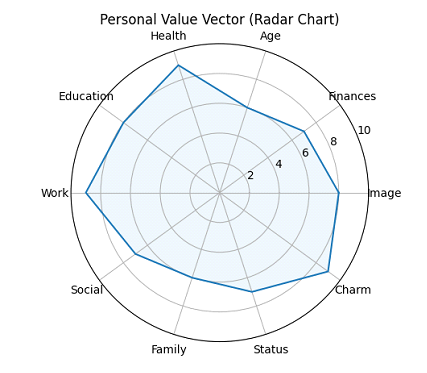
Each person can be represented as a vector of traits, creating an individual profile across multiple dimensions.
A Person Is More Than a Single Number
Rather than assigning one fixed value to a person, the proposed framework describes an individual through a multidimensional vector of characteristics.
Multidimensional Human Profile
Components of the Human Vector
These dimensions create an individual's descriptive profile, as objectively as the model allows. Their importance to another person is a separate question.
Attraction Is a Weighted Projection
Attraction is not simply the person's vector itself. Different people value different characteristics, so the same person can be perceived differently by different observers.
Different People. Different Weights.
Every individual has a personal preference vector. The importance they assign to appearance, ambition, education, personality, or other traits shapes their perception of another person.
A person does not have one fixed attraction value for everyone.
The observer's weighting of traits changes the evaluation.
Two people may evaluate the same individual very differently.
“Same vector. Different weights.”
Attraction is subjective because it depends on the preferences of the person doing the evaluating.
The Physics of Human Connection
The social field is an analogy that describes relationships as dynamic systems of emotional influence rather than static evaluations.
Emotional Closeness Changes the Strength of Influence
In the proposed model, each person generates a social field. Its influence depends on how much one person values another and the emotional distance between them.
Connection Is Not Just About Traits
Someone who may not appear exceptional in a conventional comparison can still feel deeply attractive because of emotional closeness. Conversely, growing emotional distance may weaken an otherwise strong attraction.
Why Perceived Value Changes Over Time
Relative value is not fixed. The proposed model explains how behavior and shared experiences continuously influence the way people perceive one another.
Behavior Can Matter More Than the Original Profile
The framework extends the attraction model by introducing a behavioral term. Kindness, support, betrayal, disrespect, and shared experiences can increase or decrease perceived value.
Value-Increasing Behaviors
Kindness, support, and meaningful shared experiences can strengthen bonding.
Value-Decreasing Behaviors
Betrayal and disrespect can contribute to resentment and reduced attraction.
“Relative value changes depending on behavior.”
How someone treats another person can become more influential than their original characteristics.
Love Beyond Rational Evaluation
The model distinguishes rational attraction, based on weighted traits, from emotional attachment, which develops through shared history and accumulated experiences.
Evaluation of Traits
Rational attraction is represented through a weighted projection of a person's characteristics.
Accumulated Emotional History
Emotional attachment depends on previous experiences, their emotional significance, and the passage of time.
Why Past Experiences Continue to Matter
The framework proposes that older emotional events gradually lose influence, but highly significant experiences can remain important for much longer.
Love Is History-Dependent, Not Just Trait-Dependent.
The Balance Behind Lasting Relationships
Relationship stability is influenced by how both partners value one another, invest emotionally, and respond to changes in the relationship.
Mutual Investment
When both partners consistently move toward one another, the relationship has a stronger foundation for stability.
Pursuit & Withdrawal
When one partner continually pursues connection while the other withdraws, imbalance can increase over time.
Healthy Relationships Depend on Mutual Movement
Within the model, a balanced relationship is more stable, while growing asymmetry can create pursuit, withdrawal, and eventual separation.
Strengths & Limitations
The framework offers a mathematical way to think about attraction and relationship dynamics while acknowledging the complexity of human emotions and behavior.
Strengths of the Model
Concepts that provide a useful foundation for the proposed framework.
Individual Differences
The vector approach recognizes that people have different combinations of traits.
Subjective Attraction
Preference weights explain why people evaluate the same individual differently.
Dynamic Relationships
Behavior and emotional experiences influence how relationships develop over time.
Limitations of the Model
Factors that make real relationships more complex than a simplified mathematical system.
Nonlinear Human Behavior
Human preferences and emotional responses are not always linear, and their weights may change.
Emotional Asymmetry
Two partners may experience and respond to the same interaction differently.
External Influences
Children, trauma, stress, and other major life events can change relationship dynamics.
A Framework for Understanding, Not a Fixed Formula for Human Behavior
The model is a conceptual tool for examining human relationships. Its mathematical analogies provide structure, but do not establish validated predictions about individual people.
Game Theory in Human Relationships
Relationships can be viewed as repeated interactions shaped by investment, uncertainty, trust, and perceived value. Each decision influences what happens next.
Every Interaction Is a Choice to Invest or Withdraw
Both partners continuously decide how much time, care, and emotional effort to contribute. The model explores how these choices shape the relationship over time.
Four Possible Investment Patterns
| Person A | Person B | Potential Outcome |
|---|---|---|
| Invests | Invests | Bond Grows |
| Invests | Pulls Back | A May Feel Rejected |
| Pulls Back | Invests | B May Begin Pursuing |
| Pulls Back | Pulls Back | Relationship Cools |
Four Relationship Investment Styles
Secure Investor
Invests when emotionally safe and communicates clearly.
Anxious Over-Investor
May increase investment when afraid of losing the relationship.
Avoidant Withdrawer
May pull back when emotional stakes feel overwhelming.
Opportunistic Optimizer
Invests primarily when the expected payoff appears favorable.
Consistency Is a Stronger Signal Than Words Alone
Time, care, protection, emotional repair, reliability, and showing up during difficult moments provide meaningful evidence of investment.
Understanding Relationship Stability
The proposed model examines relationship stability through feedback loops, mutual investment, trust, perceived value, and emotional volatility.
Stability Is a Dynamic Process, Not a Static Score
Relationships evolve as each interaction changes trust, investment, and emotional responsiveness. The framework considers these changes over time.
Four Components of Relationship Stability
Alignment
Compatibility between values, lifestyles, and long-term direction.
Reciprocity
The balance of time, care, and emotional investment between partners.
Trust
The accumulated influence of past actions, reliability, and emotional repair.
Volatility
The frequency and intensity of emotional fluctuations and instability.
How the System Changes
Each interaction can influence three important relationship variables.
Feeling valued may encourage greater investment; feeling rejected may reduce investment or increase anxious pursuit.
Positive experiences can build trust, while conflict and harmful behavior may weaken it.
Respect and care can increase perceived value; disrespect and instability can decrease it.
Possible Relationship Outcomes
Stable Relationship
Increasing trust, balanced investment, and lower volatility support a lasting bond.
Anxious–Avoidant Cycle
Inconsistent investment and high volatility can produce unpredictable pursuit and withdrawal.
Relationship Breakdown
When trust becomes critically low and meaningful investment stops, separation may follow.
Two Imperfect People Can Build a Stable System
Stability depends not simply on individual attractiveness or perceived value, but on how partners consistently invest, respond, and repair their connection. This remains a conceptual model rather than a clinically validated prediction tool.
The Expectation–Pressure–Resistance Loop
When expectations are not openly agreed upon, they can become sources of pressure, defensive withdrawal, and resentment within a relationship.
When Connection Begins to Feel Like Obligation
A healthy relationship relies on voluntary emotional exchange. When affection, commitment, reassurance, or attention begins to feel extracted rather than freely offered, tension can increase.
How Pressure and Resistance Reinforce Each Other
Expectation
One partner develops an expectation about the relationship.
Pressure
The unmet expectation leads to increasingly urgent demands.
Resistance
The other partner may feel controlled and begin withdrawing.
Escalation
Withdrawal increases insecurity, creating further pressure.
Seeking Security
“I need clarity about where this relationship is going.”
Protecting Autonomy
“I feel pressured to make a decision before I am ready.”
Replace Hidden Expectations With Clear Communication
Instead of silently assuming a commitment deadline, partners can discuss their desired timeline openly and decide whether their goals align.
“I'm looking for a relationship that moves toward commitment within about two years. How do you see that?”
Commitment Cannot Be Sustainably Extracted Through Pressure
Partners can communicate needs, invite commitment, observe actions, and make decisions based on genuine alignment rather than coercion.
The Four Behavioral Modes
In the proposed relationship model, interactions can be described through four behavioral modes. Each represents a different way of responding to a partner.
Steps Toward
Movement toward emotional connection through voluntary investment, affection, and cooperation.
Behavioral Expressions
Withdrawal
Movement away from connection, potentially reflecting emotional distance, uncertainty, or self-protection.
Behavioral Expressions
Pulling / Forcing
Attempts to control outcomes through pressure, repeated demands, or enforced expectations.
Behavioral Expressions
Punishment
Responses involving anger, retaliation, humiliation, or emotional attack.
Behavioral Expressions
These Are Dynamic States, Not Fixed Personalities
A person may move between these modes depending on emotional safety, stress, expectations, and the history of interactions. The model describes patterns of behavior rather than permanent character types.
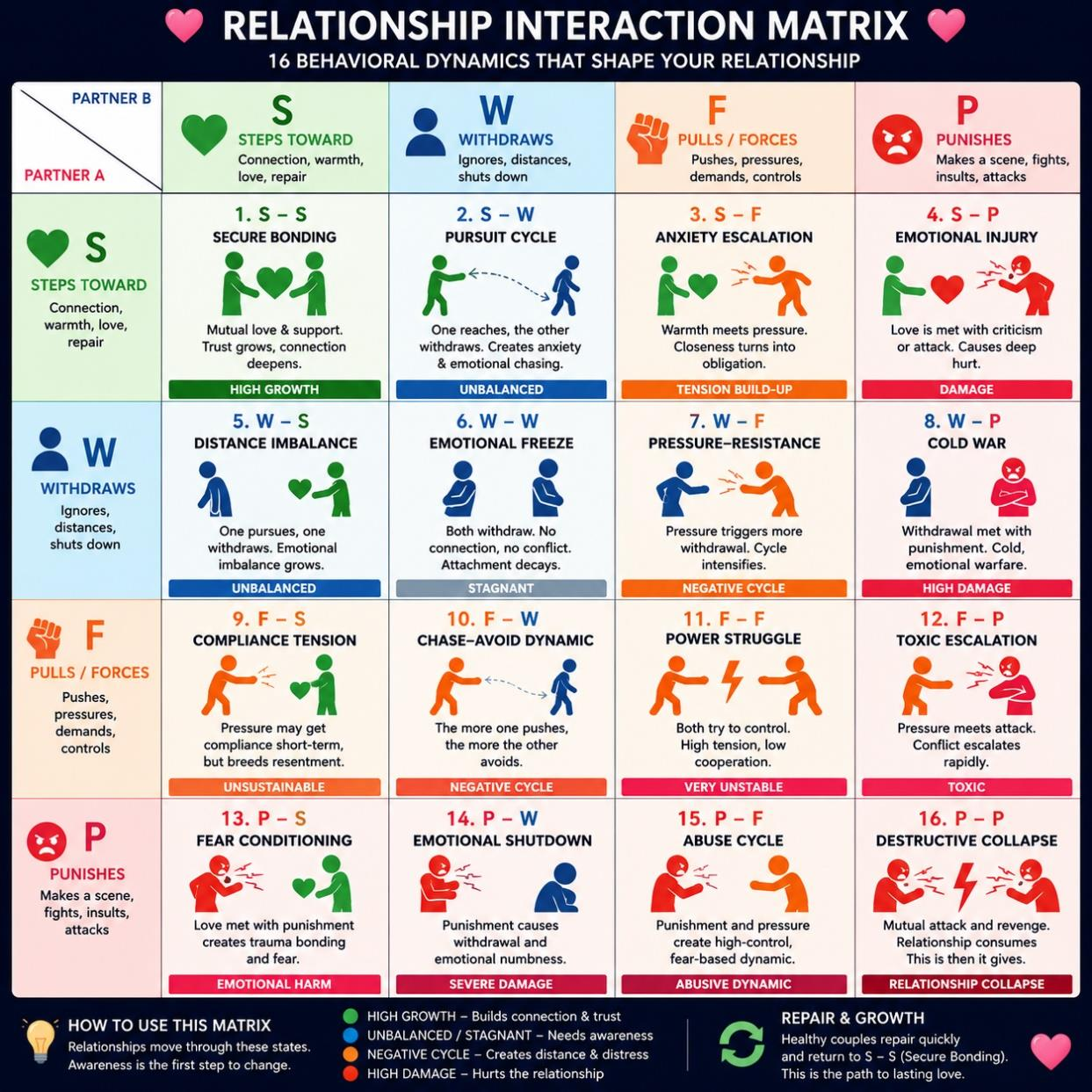
The 4×4 Relationship Matrix
By placing Partner A's behavior on one axis and Partner B's behavior on the other, the framework identifies sixteen possible interaction states and their proposed relationship dynamics.
| PARTNER A ↓ / PARTNER B → | S — Steps Toward | W — Withdraws | F — Forces | P — Punishes |
|---|---|---|---|---|
| S — Steps Toward | S–SSecure Bonding | S–WPursuit Cycle | S–FAnxiety Escalation | S–PEmotional Injury |
| W — Withdraws | W–SDistance Imbalance | W–WEmotional Freeze | W–FPressure–Resistance Loop | W–PCold War |
| F — Forces | F–SCompliance Tension | F–WChase–Avoid Dynamic | F–FPower Struggle | F–PToxic Escalation |
| P — Punishes | P–SFear Conditioning | P–WEmotional Shutdown | P–FAbuse Cycle | P–PDestructive Collapse |
On mobile, swipe horizontally to explore all 16 interaction states.
A Relationship Is a Continuously Changing System
Couples may move between different cells as trust, stress, attachment, and behavior change. These are conceptual interaction patterns, not fixed diagnoses or validated probabilities.
The Sixteen Relationship Scenarios
Each combination of Steps Toward (S), Withdrawal (W), Forcing (F), and Punishment (P) creates a different interaction pattern within the proposed relationship model.
When Partner A Moves Toward Connection
Secure Bonding
Both partners move toward one another through warmth, care, and mutual investment. Trust and attachment can strengthen.
Pursuit Cycle
One partner reaches for connection while the other retreats, potentially increasing anxiety and uncertainty.
Warmth Meets Pressure
Voluntary affection encounters demands, potentially turning closeness into a sense of obligation.
Emotional Injury
Attempts at affection or repair are met with criticism, anger, or humiliation, reducing emotional safety.
When Partner A Moves Away
Distance Imbalance
One partner withdraws while the other continues investing, creating an uneven emotional workload.
Emotional Freeze
Both partners retreat. Conflict may decrease, but connection can also weaken without renewed investment.
Pressure–Resistance
One person retreats while the other increases demands, reinforcing the cycle of avoidance and pursuit.
Cold Emotional Conflict
Withdrawal encounters punishment, potentially creating resentment, silence, and prolonged emotional distance.
When Partner A Applies Pressure
Compliance Tension
A caring partner may accommodate pressure temporarily, but repeated demands can create exhaustion or resentment.
Chase–Avoid Dynamic
Increasing pressure is met with greater withdrawal, creating a reinforcing cycle of pursuit and distance.
Power Struggle
Both partners attempt to control outcomes, increasing conflict and reducing emotional cooperation.
Toxic Escalation
Pressure is met with retaliation, creating a potentially rapidly escalating conflict pattern.
When Partner A Responds With Punishment
Fear Conditioning
Punishment directed toward a caring partner may make attempts at connection feel emotionally unsafe.
Emotional Shutdown
Repeated punishment can contribute to detachment, reduced openness, and eventual disengagement.
Abuse Cycle
Punishment and force interact, potentially producing a high-control and harmful relationship dynamic.
Destructive Collapse
Mutual retaliation, humiliation, and scorekeeping dominate, consuming rather than generating relational energy.
Healthy Relationships Are Defined by Their Ability to Repair
Partners may temporarily enter difficult interaction states during stress or conflict. What matters is whether they can restore emotional safety, mutual responsiveness, and voluntary investment rather than remaining trapped in harmful patterns.
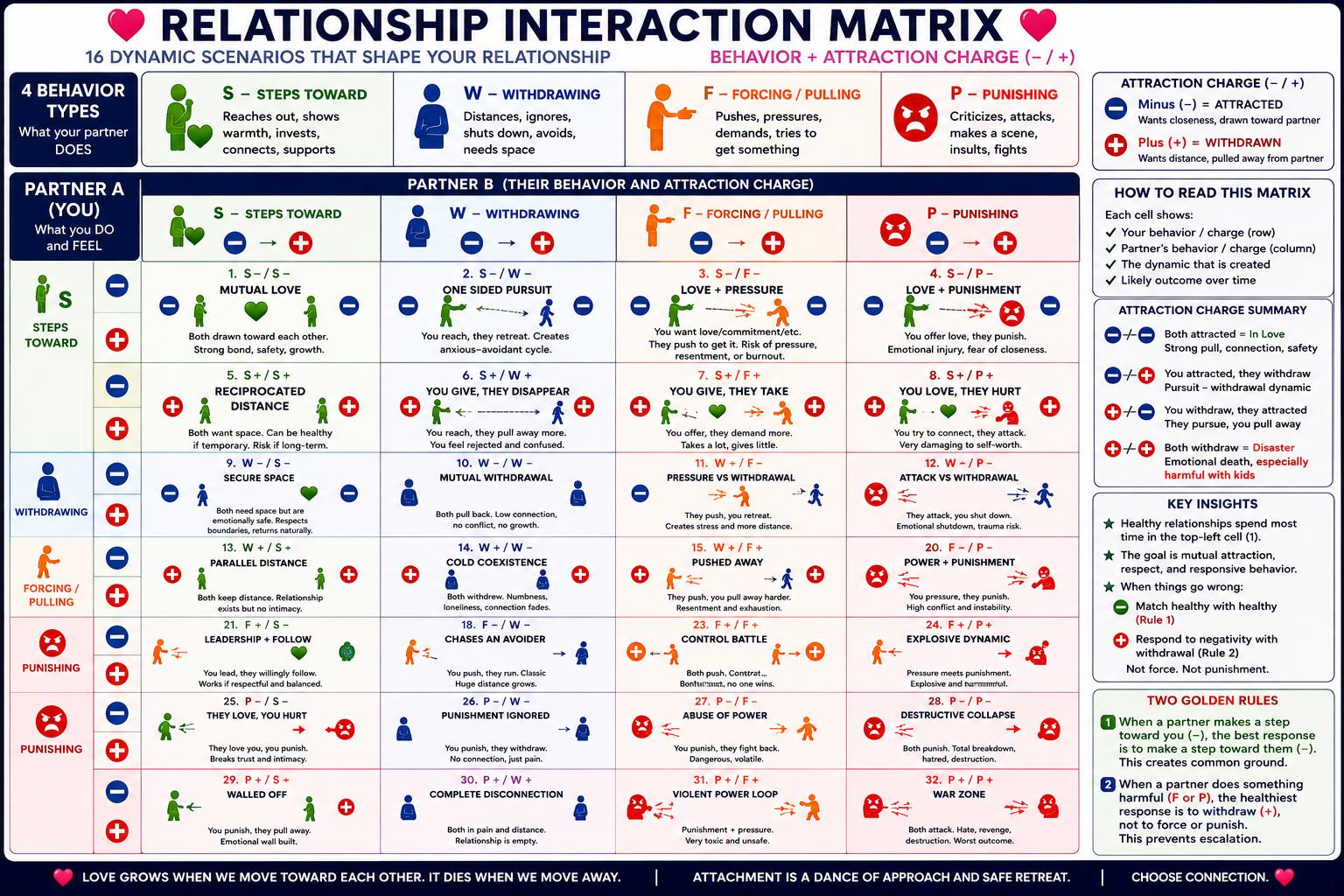
Two Core Rules of Healthy Relationships
The proposed framework identifies two stabilizing principles: reinforce healthy movement toward connection and avoid escalating destructive behavior.
Match Positive Movement With Positive Movement
When one partner makes a healthy step toward the other, the stabilizing response is another voluntary step toward connection.
Mutual positive investment can strengthen trust, emotional safety, shared experiences, and attachment.
Respond to Negative Behavior Without Escalation
When a partner behaves destructively, a regulated pause, clear boundaries, and non-retaliation can interrupt escalating conflict.
Healthy de-escalation creates space for emotional regulation without punishment, retaliation, or silent cruelty.
Responding to Different Behaviors
Steps Toward
Respond with voluntary warmth and reciprocal connection.
Force / Pressure
Set boundaries and take a regulated pause if needed.
Punishment / Attack
Prioritize safety, boundaries, and non-retaliation.
Withdrawal
Offer a gentle invitation without increasing pressure.
Reinforce Healthy Behavior. Interrupt Destructive Patterns.
Strong relationships depend on voluntary reciprocity, respectful boundaries, and the ability to restore emotional safety after conflict.
The Relationship Charge Model
The proposed model uses positive and negative charge symbols as an analogy for the direction of emotional movement between partners.
Emotional Charge Describes Direction, Not Moral Value
In this framework, minus represents movement toward connection, while plus represents movement away. Neither symbol means a person is inherently good or bad.
Attraction / Movement Toward
A desire for emotional closeness, intimacy, bonding, and shared connection.
Withdrawal / Movement Away
A desire for distance, autonomy, emotional protection, or temporary separation.
Patterns of Emotional Movement
Mutual Attraction
Both partners seek closeness and connection. Mutual responsiveness can support bonding, trust, and positive emotional momentum.
Pursuit–Withdrawal
One partner seeks closeness while the other seeks distance. This asymmetry can contribute to emotional pressure and uncertainty.
Mutual Withdrawal
Both partners move away from emotional connection. Without renewed investment, attachment may gradually weaken.
A Dynamic Emotional System
Emotional direction can change over time as personal circumstances and relationship experiences evolve.
Attachment Is Directional
The framework proposes that a healthy relationship depends on both partners continuing to orient toward one another, rather than relying solely on obligation, routine, or external commitments.
Age-Dependent Attachment Formation
The proposed framework explores how neuroplasticity, reward, emotional memory, and familiar relationship patterns may influence the formation of attachment across different life stages.
Two Pathways to Emotional Attachment
The model proposes that attachment can develop through the formation of new emotional associations or the reactivation of familiar emotional patterns.
CONNECTION
Plasticity & Emotional Resonance
Plasticity-Based Bonding
The framework associates this pathway with the creation of new emotional connections and responses to novel experiences.
New emotional pathways and experiences.
Resonance-Based Bonding
This pathway describes how familiar emotional, intellectual, or interpersonal patterns may reactivate previous associations.
Emotional familiarity and associative memory.
“I Have Seen This Emotional Pattern Before.”
The proposed theory suggests that a new relationship can sometimes feel immediately familiar when it resembles meaningful patterns from earlier experiences.
What May Influence Attachment Formation?
Capacity for learning and adaptation.
Emotional significance and novelty.
Similarity to existing associations.
Emotionally meaningful experiences.
Stress, exhaustion, and previous adversity.
Attachment Potential Does Not Disappear With Age
The model distinguishes new emotional learning from the activation of familiar emotional associations. Both are proposed as possible contributors to attachment throughout adulthood, without assuming that either pathway is exclusive to a particular age group.
Research note: This is a conceptual framework. Its age-related mechanisms and mathematical predictions require empirical testing.The Dynamics of Relationship Energy
Relationships are not static structures. They evolve through continuous interactions that influence trust, attraction, emotional safety, attachment, and the willingness to invest in one another.
A Relationship Is a Living, Evolving System
The proposed framework brings together ideas from attachment psychology, behavioral dynamics, game theory, and systems thinking to describe how relationships may change over time.
What Shapes Relationship Stability?
Mutual Investment
Voluntary acts of care, support, affection, and responsiveness can reinforce emotional connection.
Connection Through ReciprocityEmotional Safety
Trust, predictability, and respectful communication create conditions in which emotional openness can develop.
Security Through ConsistencyDynamic Responses
Each interaction can shift perceived value, trust, attachment, and the direction of emotional movement.
Change Through InteractionRepair & Recovery
Relationships can recover from difficult interactions when partners restore boundaries, responsiveness, and trust.
Resilience Through RepairEvery Interaction Influences the Next
The framework treats relationship development as a sequence of interconnected behavioral and emotional changes.
Interaction
A partner acts or responds.
Interpretation
The behavior receives emotional meaning.
Emotional Update
Trust and attachment may change.
Future Response
The next interaction is influenced.
What Strengthens Connection?
- Voluntary mutual investment
- Respectful communication
- Emotional responsiveness
- Trust-building behavior
- Repair after disagreement
What Weakens Connection?
- Persistent emotional withdrawal
- Escalating pressure and demands
- Punishment and retaliation
- Repeated violations of trust
- Unresolved resentment
Stable Relationships Are Built Through Repeated, Voluntary Movement Toward One Another.
The central idea of this conceptual framework is that relationship stability depends less on an idealized evaluation of either partner and more on the ongoing balance between investment, emotional safety, withdrawal, pressure, and repair.
Research note: This section synthesizes the proposed conceptual framework. It should not be interpreted as a scientifically validated mathematical prediction model.
Conclusion & Future Directions
A unified conceptual perspective on human relationships, emotional energy, attachment, and behavioral interaction. Exploring how individual perceptions and repeated choices may influence the evolution of interpersonal bonds.
Human Relationships Are Dynamic Systems Shaped by Perception, Investment, and Emotional Response.
This proposed framework brings together mathematical analogies, behavioral interaction models, and relationship dynamics to explore how attraction, trust, reciprocity, and emotional distance may change over time.
Rather than treating relationships as fixed outcomes, the framework examines them as evolving systems in which every meaningful interaction can influence future behavior.
CONNECTION
Four Central Ideas of the Framework
The model organizes complex interpersonal behavior into four interconnected concepts.
Perceived Human Value Is Relative
Different individuals assign different importance to personal qualities. Attraction and perceived compatibility therefore depend partly on the observer's preferences.
Interactions Continuously Update Relationships
Support, kindness, conflict, betrayal, and shared experiences can influence trust, attachment, and perceived relational value.
Reciprocity Supports Stability
Mutual emotional investment and respectful responses can help maintain connection, while persistent imbalance may contribute to instability.
Behavioral Patterns Shape Future Outcomes
Steps toward connection, withdrawal, pressure, and punishment may create recurring interaction patterns that influence relationship development.
Future Research Directions
Transforming the conceptual framework into a testable scientific model would require clear definitions, measurable variables, empirical observations, and rigorous validation.
Mathematical Formalization
Define measurable variables for attraction, investment, emotional distance, trust, and relationship stability.
Longitudinal Relationship Studies
Observe how emotional responses and interaction patterns change over extended periods.
Behavioral Model Validation
Evaluate whether the four behavioral modes and their combinations reliably describe real-world relationship interactions.
Predictive Model Testing
Test whether changes in reciprocity, trust, and emotional volatility are associated with later relationship outcomes.
Cross-Cultural Research
Examine how social expectations, cultural values, and relationship norms influence the proposed dynamics.
A Path Toward Scientific Evaluation
Define the theoretical structure.
Develop observable indicators.
Collect and analyze evidence.
Revise the theory using findings.
Understanding Relationships Requires Understanding Not Only Who People Are, but How They Continuously Respond to One Another.
The proposed mathematical theory of human energy offers a structured way to explore interpersonal perception, attraction, attachment, and behavioral feedback. Its long-term value will depend on whether its concepts can be translated into measurable, testable, and reproducible findings.
This is a proposed conceptual framework. The mathematical analogies, behavioral classifications, and predictive mechanisms presented here should not be interpreted as scientifically established findings without independent empirical validation.