
A Mathematical Theory of Human Energy
Toward a Unified Model of Psychological Vitality, Addiction, Attachment, and Human Motivation
This paper proposes a conceptual mathematical framework describing human psychological energy as a dynamic system generated through interaction with twelve primary life resources.
The model treats emotional vitality, motivation, resilience, creativity, and attachment as outputs of an internal energy economy governed by reinforcement, depletion, investment, and decay.
Understanding the Energy Behind Human Experience
Individual Sources
Internally cultivated and stability-producing resources.
Social Sources
Externally interactive resources with potentially addictive dynamics.
Unified Model
Drawing analogies with economics, thermodynamics, and portfolio theory.
What Is Psychological Energy?
The human brain continuously converts experience into psychological energy.
The capacity of a human being to initiate action, sustain motivation, experience vitality, regulate emotion, create meaning, and pursue long-term goals.
PSYCHOLOGICAL ENERGYMore Than Emotion or Biology
This energy is neither purely emotional nor purely biological. Within the proposed framework, it emerges from multiple interconnected dimensions of human experience.
The Twelve Energy Sources
The proposed framework identifies twelve primary resources through which human psychological energy is generated.
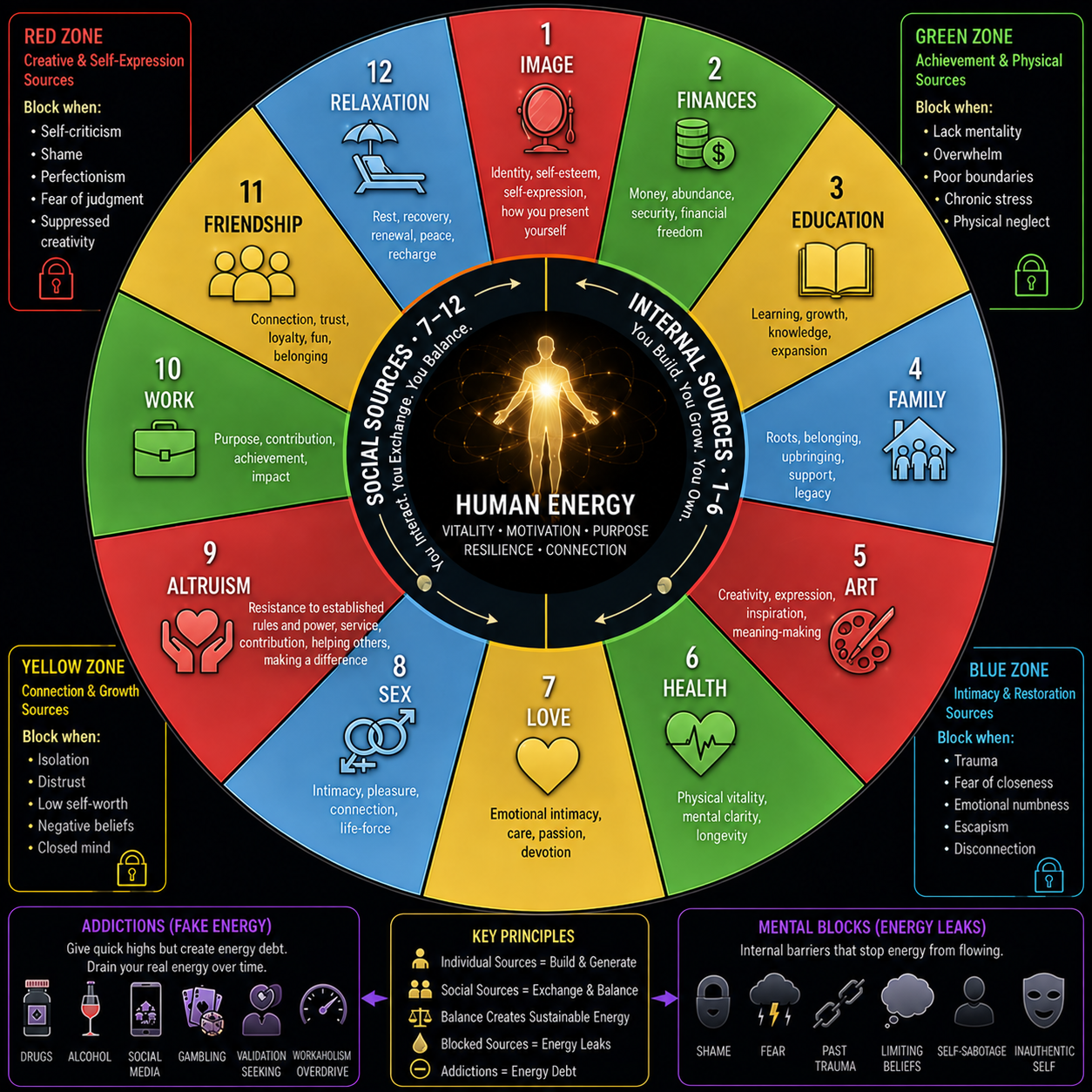
A visual representation of the twelve interconnected internal and social energy sources.
Individual Sources
Internally cultivated and stability-producing.
Social Sources
Externally interactive and potentially addictive.
Two Dimensions of Human Energy
The model distinguishes internally cultivated energy from externally reinforced energy.
Individual Sources
Sources 1–6
Image, Finances, Education, Family, Art, and Health are classified as internal sources of energy.
These sources generate:
- Stability
- Self-worth
- Resilience
- Identity coherence
- Sustainable motivation
Social Sources
Sources 7–12
Love, Sex, Altruism, Work, Friendship, and Relaxation are classified as social sources of energy.
These sources generate:
- Stimulation
- Emotional intensity
- Novelty
- Reinforcement
- External validation
In this framework, altruism encompasses resistance to established rules and power, service, contribution, helping others, and making a difference.
Total Human Energy Function
The proposed model describes psychological energy as a dynamic system influenced by internal resources, social reinforcement, accumulated energy debt, and blocked sources.
Psychological Energy Is a Dynamic Balance
Total psychological energy at a given time is modeled through the interaction of energy-producing resources and energy-reducing factors.
Internal Energy
Energy generated through individual resources, weighted according to their contribution.
Social Energy
Energy associated with social interaction, connection, and external reinforcement.
Energy Debt
Accumulated energy debt reduces the overall balance of the psychological energy system.
Blocked Sources
Penalties represent the reduced contribution of resources that are partially or fully blocked.
How Human Energy Is Generated
Principle 1 — Constructive Effort Generates Energy. Within the proposed framework, energy emerges when effort, growth, meaning, connection, risk, and achievement are aligned.
Constructive Effort Generates Energy
Meaningful activity strengthens the system when it supports competence, autonomy, identity coherence, emotional connection, or biological health.
Effort & Growth
Constructive effort and personal growth contribute to the development of competence and autonomy.
Meaning & Connection
Cognitive meaning, emotional connection, and identity coherence strengthen the motivational system.
Risk & Achievement
Purposeful challenges and achievement can reinforce motivation and a sense of forward progress.
Constructive activity increases competence, autonomy, identity coherence, emotional connection, or biological health.
When Energy Sources Become Blocked
A blocked source cannot efficiently produce energy. The proposed framework examines how different life circumstances can restrict the contribution of individual and social resources.
A Blocked Source Cannot Efficiently Produce Energy
A source may become partially or fully blocked, reducing its effective contribution to the overall psychological energy system.
Image
Shame can block the energy associated with Image.
Finances
Debt can restrict financial stability and its energy contribution.
Family
Trauma can interfere with the energy associated with Family.
Health
Illness can reduce the contribution of physical well-being.
Friendship
Isolation can restrict the energy generated through friendship.
Understanding Source Availability
Each source is assigned a functional state, ranging from fully functional to fully blocked. Its effective energy contribution is adjusted according to that state.
The Hidden Cost of Artificial Stimulation
Within this conceptual framework, addiction is described as artificial energy extraction without proportional internal generation.
“Addiction is artificial energy extraction without proportional internal generation.”
The model proposes that reward signals can become disconnected from meaningful construction.
Examples of Artificial Stimulation
Artificial Reward
Artificial stimulation can provide immediate reward or a temporary increase in perceived psychological energy.
Accumulating Energy Debt
The framework proposes that repeated artificial stimulation creates energy debt, reducing sustainable psychological vitality over time.
Potential Consequences in the Model
The Energy of Human Connection
Humans exchange energy socially. Within the proposed model, relationships become stable when both partners produce internal energy and exchange social energy symmetrically.
Two Forces Shape Relationship Dynamics
The attraction vector and withdrawal vector describe opposing dynamics that influence closeness, investment, and relationship stability.
Positive Attraction
Attraction represents the forces that encourage emotional connection and investment in a relationship.
Emotional Withdrawal
Withdrawal represents forces that encourage emotional distance and reduced relationship engagement.
Understanding Relationship Stability
Balanced attraction and reciprocal social energy exchange support relationship stability.
Instability emerges when withdrawal exceeds attraction.
The Cost of Emotional Extraction
Within the proposed framework, emotional extraction occurs when one partner attempts to forcibly obtain emotional or relational resources from another, creating an imbalance in the relationship.
When Emotional Demands Become Depletion
Forcing validation, commitment, affection, reassurance, sex, or emotional labor creates energetic asymmetry between partners.
Forms of Emotional Extraction
The Consequences of Extraction Pressure
The model proposes that extraction pressure increases partner depletion according to emotional depletion sensitivity.
How Attachment Develops Over Time
Attachment strengthens through repeated emotional reinforcement over time. The model examines how emotional experiences accumulate and how memories gradually decay without continued reinforcement.
Connection Is Built Through Repetition
Attachment is modeled as a dynamic process shaped by emotional reinforcement events and a memory decay coefficient.
The ongoing interaction between emotional experiences and memory.
Emotional Reinforcement
Repeated closeness and positive emotional experiences strengthen attachment over time.
Attachment Accumulation
Reinforcement events contribute to the accumulation of emotional attachment.
Memory Decay
Without continued reinforcement, the influence of emotional memories gradually decreases.
Repeated closeness strengthens attachment, but memories gradually decay without reinforcement.
Young vs Older Brains
The proposed model considers how neuroplasticity and emotional experience may influence attachment formation at different stages of life.
Rapid Attachment Formation
The framework associates younger brains with greater responsiveness to novelty and faster attachment formation.
Established Emotional Pathways
The framework proposes that older individuals may form attachment more slowly while retaining the ability to reactivate existing emotional pathways.
Attachment Is a Dynamic Process
The model introduces a neuroplasticity coefficient to describe age-related differences in attachment dynamics. These are theoretical generalizations, not fixed rules for every individual.
Understanding Energy Depletion
Within the proposed framework, burnout occurs when social output exceeds internal regeneration, resulting in a sustained imbalance within the psychological energy system.
When Output Exceeds Regeneration
Burnout is modeled as a condition in which the demand placed on the energy system becomes greater than its ability to regenerate internal resources.
Four Symptoms Identified in the Model
Emotional Exhaustion
A state of diminished emotional resources and persistent exhaustion.
Cynicism
A negative or detached attitude toward previously meaningful experiences.
Emotional Numbness
Reduced emotional responsiveness and a diminished sense of vitality.
Motivational Collapse
A significant reduction in initiative, drive, and engagement.
Rest, Recovery & The Relaxation Paradox
The theory proposes that relaxation restores energy after meaningful expenditure, while relaxation without constructive engagement may become sedative rather than restorative.
“Relaxation restores energy only after meaningful expenditure. Unearned relaxation becomes sedation.”
Healthy Relaxation
Relaxation that follows meaningful effort is proposed to restore psychological energy and support recovery.
Sedative Relaxation
The model proposes that relaxation dominated by sedation can weaken motivation and initiative.
The Balance Between Recovery and Sedation
The framework distinguishes restorative relaxation from sedative relaxation by considering their effects on the wider energy system. This is a proposed theoretical distinction, not a rule that rest must be earned.
Life as an Energy Portfolio
Human beings continuously allocate time, attention, emotional capital, and physical effort across energy-producing assets. The framework draws a parallel between personal well-being and portfolio management.
Every Life Is a Portfolio of Energy Investments
Our choices determine where energy is invested, how resources are developed, and how the overall system responds to change.
Time
The time invested in activities, relationships, and meaningful pursuits.
Attention
The focus directed toward different energy-producing resources.
Emotional Capital
The emotional resources invested in personal and social experiences.
Physical Effort
The physical energy allocated to constructive activities and progress.
Healthy Lives
Resemble diversified portfolios.
Toxic Lives
Resemble leveraged debt structures.
One Person. Different Energy States.
The theory proposes that the same person, depending on their internal state, can feel and behave like completely different people.
High-Energy State
When the energy system is active and supported.
Depleted State
When psychological energy becomes significantly reduced.
“Human beings are not static objects. Human beings are dynamic systems.”
A person's behavior in one chapter of life may not represent their enduring character. Changes in love, health, meaning, friendship, purpose, and creativity can influence how they experience and engage with the world.
How One Source Can Reactivate the Others
Human energy systems are interconnected, not isolated. The model proposes that activating one powerful source can stimulate motivation and investment across other areas of life.
One Active Source Can Illuminate the Entire System
When love, meaning, or another major source becomes active, the wider motivational system may respond with renewed interest in health, creativity, work, and future goals.
The Upward Reinforcement Cycle
Reduced Stress Restores Motivation and Creativity
The system begins reinforcing itself upward as progress in one domain supports other energy-producing resources.
Energy Loss Can Also Spread
When a major source such as Love or Work is lost, the framework proposes that motivation, health, self-care, social connection, and creativity may also decline, creating a downward cycle.
The Power of Human Influence
Humans exchange energy between sources. The theory proposes that spending time with someone who has a deeply developed source of Love, Education, Art, Health, or Work can influence our own motivation and emotional state.
“Like using one flame to light another candle.”
One person's motivation, creativity, or enthusiasm can inspire similar energy in those around them.
Five Sources of Positive Influence
Love
A loving person can make others feel worthy of love again.
Education
A deeply educated person can awaken curiosity.
Art
A creative person can reignite imagination.
Health
A healthy, disciplined person can inspire positive change.
Work
Meaningful work and purposeful action can motivate others.
Energy Can Inspire
Motivation, creativity, enthusiasm, and a sense of purpose can spread through social interaction.
Depletion Can Also Spread
The framework also considers how chronic negativity, hopelessness, cynicism, addiction, and emotional chaos can influence social environments.
We Are Interconnected Energy Systems
Humans are not closed systems. We are energetic ecosystems constantly influencing one another.
The Foundations of Human Flourishing
Within the proposed mathematical framework, sustainable human flourishing depends on maintaining a balanced, resilient, and meaningful psychological energy system.
Seven Principles of Sustainable Human Energy
The model identifies seven interconnected conditions that support a more stable and sustainable energy system.
Strong Internal Generators
Balanced Social Reinforcement
Controlled Stimulation
Limited Artificial Extraction
Meaningful Effort
Emotional Reciprocity
Long-Term Identity Coherence
Understanding the Connections That Shape Our Lives
Exploring how energy, motivation, attachment, and meaningful human experiences interact within a dynamic system.
Victoria Kurbatova Engineer & Writer